

Welcome to The Reservation, a tPH letter including long-form analysis and cultural criticism of the hospitality industry and relevant trends.
In this letter: a crash course in nihilism, what Nietzsche would think of brain rot, why Gen Z is going into debt to travel, and the role of hospitality when nothing matters (or does it?)
“What does Nihilism mean? That the highest values are losing their value. There is no bourne [goal]. There is no answer to the question: ‘to what purpose?’”
– Friedrich Nietzsche in The Will to Power
Dear guest,
I have noticed a particular sense of strain and malaise in the air lately, especially in my group of peers - Gen Z.
While cycles of spiritual burnout are nothing new, nor are they unique to Gen Z, I am noting that the oscillation between grandeur and soul-wrenching gloom is getting quicker. All of this is impacting travel habits and the role of hospitality in society.
Enjoy! Or not! Who cares?
An era marked by nihilism
Nihilism, in its most simplistic, pop-philosophy form, is the belief that life has no inherent meaning, purpose, or value, but also carries the implication of ‘nothing matters, so why do anything at all?’.
When Nietzsche wrote about it in the late 1800s, he was examining what happens to a culture when the values which it was built on no longer have authority or consensus behind them. In his time and context in Europe, the values set by religion lost their status as universal, which led to entire societies feeling like the rug had been pulled from under their feet in the existential sense.
This is where Nietzsche’s famous outburst ‘God is dead’ stems from, and he warned that this would eventually push Europeans toward a kind of paralyzed despair.
There is an important nuance here, namely between active and passive nihilism. The latter is the equivalent to kicking your feet up and staring into the ether, waiting for it all to implode, while active nihilism presents an opportunity: the collapse of old values can make space for new ones.
What would Nietzsche think of brain rot?
From where we stand a century and a half later, I would dare to say that nihilism has become the steady, lulling background hum of culture. Oxford University Press named ‘brain rot’ the word of the year back in 2024, officially making mental decay by overconsumption of slop a shared concern.

Our humor has become very absurdist and self-erasing, our movies are reboots of reboots, and with the endless push towards growth, grit and texture has been flattened to aesthetics.
And don’t get me started on spending, with the surge of meme coins, sports betting, prediction markets, and spread betting, which all signal a growing sense that the future is nothing more than a bet.
Financial nihilism
I feel like the latest generation to enter adulthood is the one that inherits the mood of its time in the most undiluted way. Older generations, at least in theory, had a logical playbook to follow; study → work hard → buy a house → climb the ladder → retire → travel.
Now, with events such as the dot-com bubble, 9/11, the 2008 global financial crisis, the pandemic, and generative AI having coincided with our timeline, most graduates are being hit with the most brutal job market in a long time. Looking at this lineup of drama, it’s actually quite impressive.

Cue: financial nihilism. Young people are now so deeply disillusioned with the traditional financial system, which they see as unfair and unpredictable, it leads them to finding it pointless to save for retirement or invest in conventional ways. Prudence and long-term planning have gone out the mafakin’ window.
A growing share of Gen Z adults do not expect to retire in the traditional sense, and only 20% of working-age zoomers are saving for retirement at all according to this study (GULP). Furthermore, 71% of zillennials think that building wealth is something increasingly out of reach for them.
Gen Z is doom spending
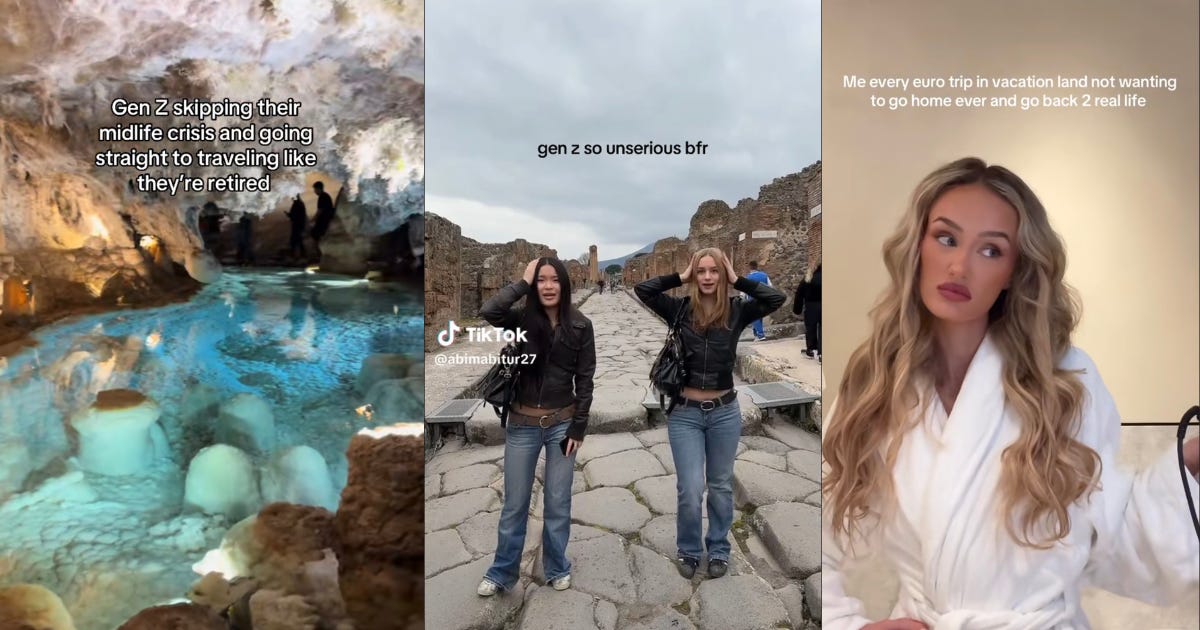
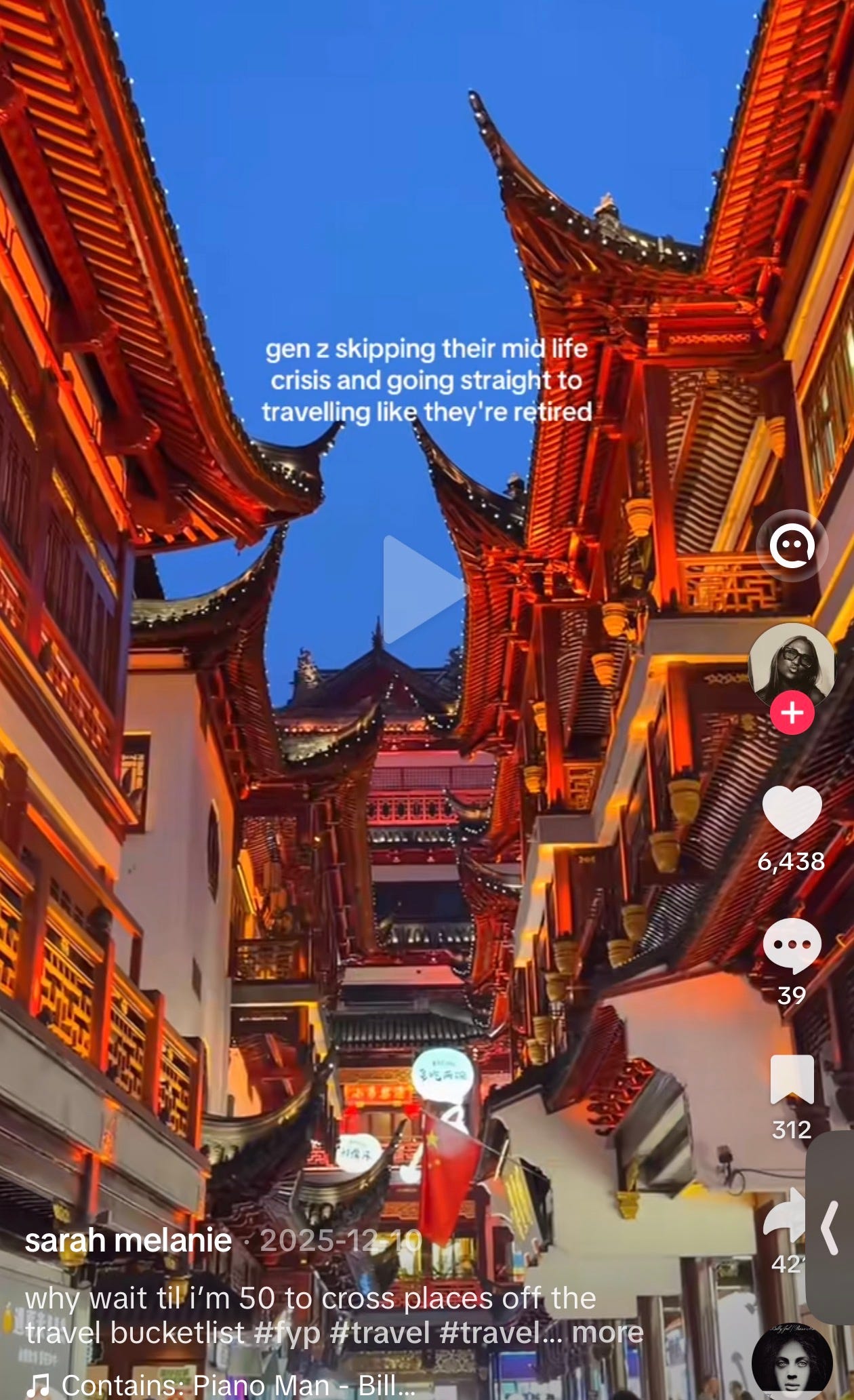
I saw this TikTok on my feed about how gen z is now ‘skipping their mid life crisis and going straight to traveling like they’re retired’:
At the same time, there are comments like this:

The answer is doom spending, i.e., buying goods and services to cope with pessimism about the economy or personal finances, oftentimes at the cost of your long-term financial situation.
Doom spending is most prevalent in Gen Z and millennials despite being less wealthy on average. And here’s the tea: more than a quarter of American adults are willing to go into debt to travel. So if a bunch of Gen Z people in your life are suddenly on a horse riding trek in Mongolia, this could be their mysterious source of income.

Travel used to be the reward at the end of a working life, but now the quite nihilistic trend of micro-retirement is taking precedence as Gen Z wants to experience the world now.
But this is not all passive nihilism, because there’s this very active element of deciding that time and experience are worth more in this moment (the only one that is promised) than some hypothetical future wealth that may never come.
I could see this further propelling the extended stay and coliving trends that are already on the rise.
Identity tourism
When you are stripped of the possibility to build your identity on an external script about what your life should look like, the self becomes something that needs to be actively constructed.
Travel and experiencing the world is great material for this, leading to identity tourism. This is in my eyes an extension of ‘-core’ culture, where travel becomes part of a performed aesthetic.

Gen Z is over-indexing on travel and hospitality spending and uses it to prove that they have taste and to earn status. This includes being in the know, an early adopter, a trend-setter rather than a sheep of the masses.
In a purely experiential way, a place stops being cool when a long, expectant queue forms in front of it. There is a rebellion against trends even though the rebellion itself is only another form of performing identity.
What does hospitality even mean?
I am not cynical enough to think that the only reason younger people travel is to perform, not at all. And if they do, it’s just a symptom of a larger issue.
Travel is existentially rewarding, even if only by deepening our sense of the inherent absurdity of life.
It is a function of the human to make meaning even when devoid of it, and we will continue to do so in our different ways. There are so many tangents I could go on from the widening wealth gap and polarization on the one hand to a democratization of knowledge and eventual end of human productivity on the other - but let’s circle back to hospitality for a moment.

Hospitality, as a philosophy and way of relating to the fellow human being, will be more important than ever given all of these changes and instability.
If we must be nihilistic, then so be it, but we can take an active stance to build new values we can subscribe to out of the rubble. A great hotel stay does not give a flip about your retirement fund or five-year plan or if your mom is proud of you. It can be an oasis of presence and very welcome escapism where we can larp an alternative existence (this is the most sophisticated conclusion I can offer you at this point hahahah).
What do you think is the role of hospitality in all of this? Does it only serve the purposes of nihilistic hedonism? Or can we rather use it as a guiding set of values in a world devoid of meaning (I think yes)?
Thank you for reading today’s tPH letter. As the first grand hôtel of the internet keeps growing, this kind of philosophical housekeeping is very important.
As always, I am glad to hear any thoughts, feelings, observations that this may have awoken in you:
Yours truly,
Emma
I think travel gives people (at least in my case) something to look forward to. I also think social media has had an outsized impact on Gen Z and Millennial travel habits.
This is incredible!