


Welcome to The Reservation, a tPH letter including long-form analysis and cultural criticism of the hospitality industry and relevant trends.
In this letter: A frantic rant about the lack of disciplined critique within the hospitality industry, hotel merch on merch on merch, Sporty & Rich’s genius hotel collab strategy, and why hospitality is the real art and asset.
The fashion industry, undeniably, holds a seat at the cultural table. For many, fashion is equal to culture.
Fashion is surrounded by an infrastructure of attention, spanning from news coverage, worldwide publications, podcasts with millions of listeners, and entire museums that all treat clothing as being worthy of serious intellectual inquiry.
The cultural impact of fashion is nothing I disagree with, because it is true that the way we dress speaks to identity, power, class, desire, belonging.
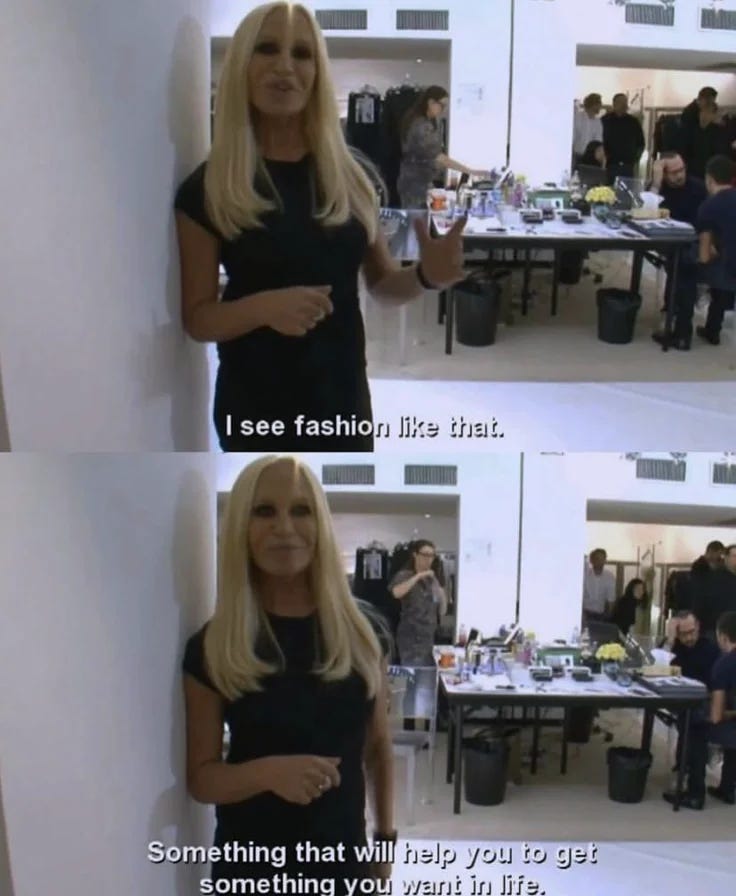
What is curious to me, however, is that hospitality delivers on all of these facets (and more), but the cultural discussion around it seems to be nonexistent.
In my opinion the hospitality industry has a tendency to reduce itself to operations, demand forecasts, occupancy rates, RevPAR, profit margins, etcetera (as a side note: I cover many of these operational topics for EHL Insights), and not much more.
There is trade press (I do enjoy myself some CoStar and Skift <3) and “top 10 hotels in x” listicles often void of substance.
Mind you, this is an industry that both literally and figuratively constructs spaces where human life happens, as people sleep, eat, gather, grieve, celebrate, and rest; and we only want to talk about the logistics of it all?
Where is the Vogue of hospitality (although some have argued that Vogue also has succumbed to reporting rather than actual cultural fashion criticism)?

Where is the joint hype for a new hotel opening as for a runway show?
There is a vast gulf between what hospitality is (and its significance) and how we talk about it.
Hospitality culture lacks structure (my rant continues)
Obviously, the hospitality industry has not failed commercially, as it has grown into a trillion-dollar global sector1 despite the trying times it faced in the 2020s.
Culturally and philosophically, however, I’m afraid it’s still in its infancy.
The industry has failed to claim its own significance and to produce the language, the criticism, the public discourse that would let people understand what makes a great hotel or restaurant so great.
The fashion industry went from being the ‘rag trade’ to generating endless cultural commentary and becoming a zeitgeist fixture. There are critics, writers, theorists (omg where are the hospitality industry theorists???), curators, and public intellectuals who exist to continuously articulate the context behind garments and collections or designer choices.
While hospitality has fantastic institutions such as EHL (my alma mater) and Cornell producing excellent managers and executives, and industry consultants who can optimize the hell out of a P&L.
But where are the hospitality critics? Not reviewers!!! Critics!!!
Where are the people asking what it means, philosophically, that we’ve built an entire economy around the idea of paying strangers to care for us? What does it say about loneliness, about community, about the failure of domestic life, that the fastest-growing segment of luxury is wellness hospitality?
Is hospitality even critiqueable?
Maybe the issue is that hospitality as a cultural object is harder to criticize.
A garment holds still, is photographable, hung at the met, and it can be argued about for forty years and the thing itself doesn’t change or disappear (even though the world around it naturally does).
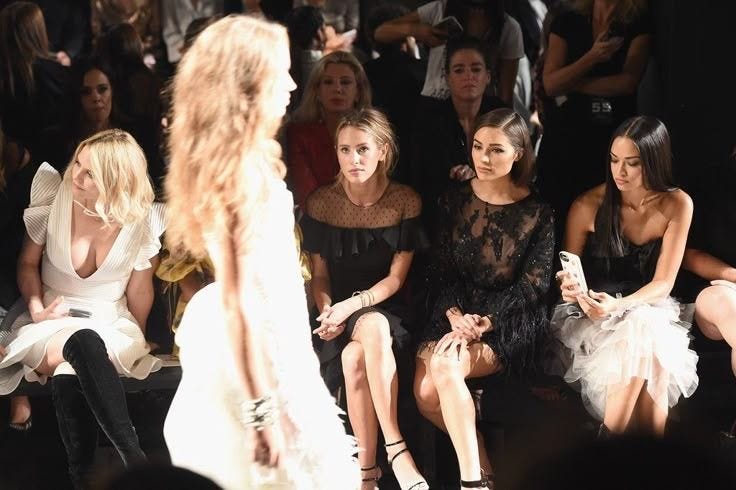
But the object of hospitality criticism would be something much more elusive, namely the felt experience (we love phenomenology2 here at tPH) of being hosted, which is private, lived once, and, then, gone; because the product of hospitality is by nature perishable.
Hospitality moments cannot be hung on the wall for everyone to admire, which brings us to the ultimate dilemma of building a public discourse around an art that leaves no artifact. You can’t march concierge down a runway (or… could you?).
(I don’t think this is unsolvable, by the way. I think it’s unsolved, which is a completely different thing).
Walk with me:
What if universities offered hospitality as a humanities subject, not just a management degree? Or imagine a TED talk about the philosophy of room service!!! And even better, what if hospitality brands would convey their values through commissioning artists, funding research, and publishing essays? Hospitality could have the chance to pioneer something amazing and thoroughly anti-anti-intellectualistic.
And the conditions are right, my friend. The wellness boom, the experience economy, the quiet luxury conversation a couple of years back, in my opinion all point to people being hungry for the thinking and values that hospitality could offer.
People are just simply missing the proper language to describe why the best hospitality experience left the impression it did, or why experiences seem to fill some void that luxury goods haven’t been able to.
BUT HERE’S THE TEA!!!!
Earlier this year, Mandarin Oriental announced its collaboration with Sporty & Rich (which has a history of hotel collaborations, including collections with the Carlyle, the Sunset Tower Hotel, and Le Bristol, to name a few), and Frame is on its 5th collection with Ritz Paris.
Unfortunately, I don’t think this is a sign that hospitality is finally entering the zeitgeist, but that fashion is colonizing the cultural capital of hospitality. There! I said it.
Frame is selling the feeling of Ritz Paris, its heritage and sense of being cared for that people associate with the hotel, either targeting brand loyalists or aspirational shoppers who can afford a cashmere sweatshirt but not a stay at the premises.
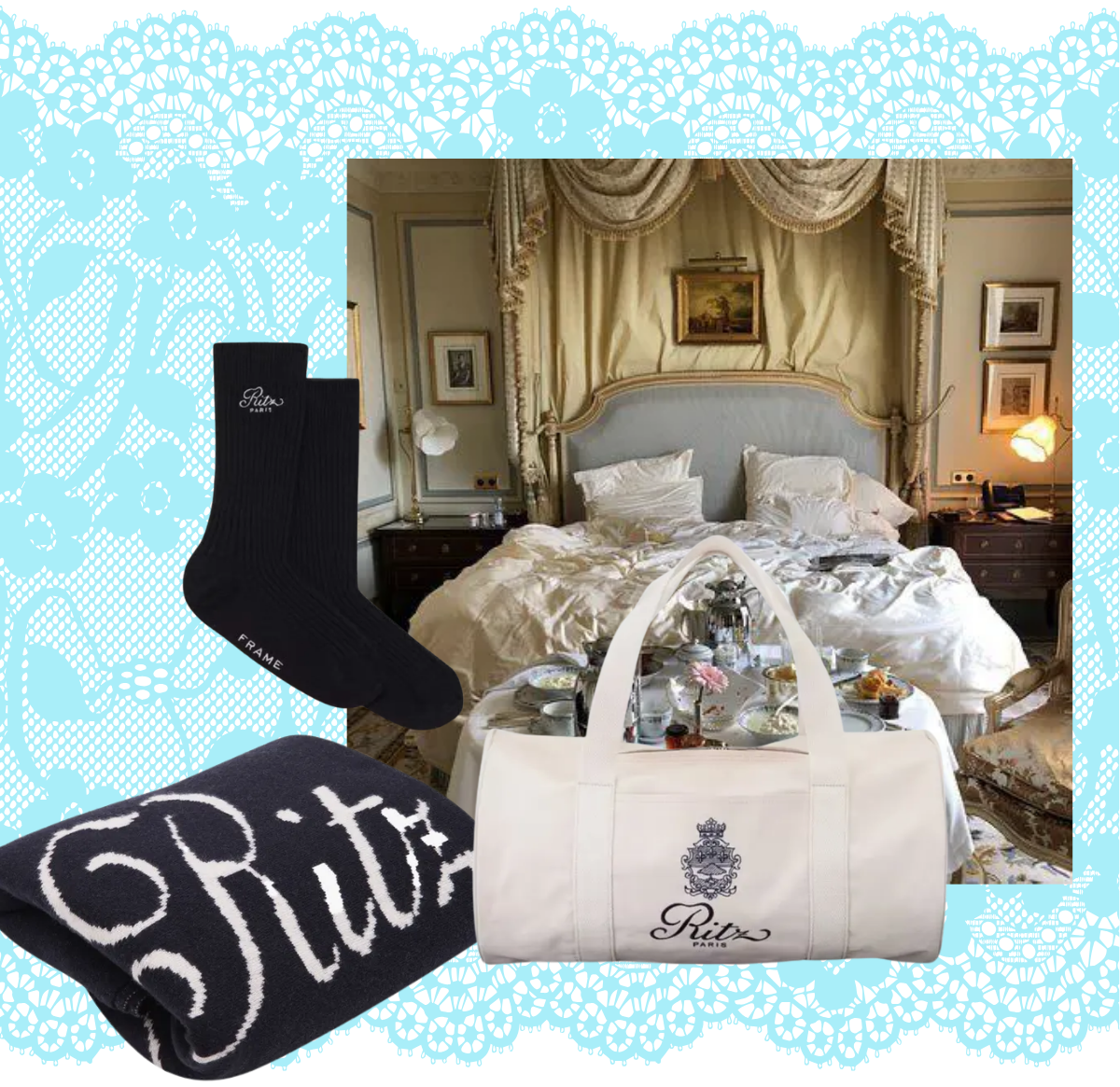
But the gag is that Sporty & Rich actually needs the hotels more than they need S&R, because without the hotel the old-money-wellness-fantasy is just a font on any other sweatshirt.
The cultural capital is flowing from hospitality to fashion, because the fashion industry has recognized the enormous emotional and cultural power that hospitality holds. The feeling I get is that the hospitality industry is just flattered to be noticed rather than making a claim for that cultural power on its own terms.

Visibility is a gift and a threat
There is a caveat that the fashion industry learnt the hard way: namely, that cultural visibility cuts both ways. The same critics and journalists that elevated fashion to art have also held it accountable for sweatshops, waste, and burning unsold products.
Now that spending and attention alongside it are migrating towards transformative luxury and hospitality, the scrutiny will hit the industry. The brands that underpay and mistreat staff or blatantly greenwash their sustainability claims will hear about it.
The huge opportunity is for the brands that are invested in bettering the industry and being part of the cultural conversation. Where there is integrity, there will be a lot of gain when hospitality finally gets its cultural moment.
Back to hospitality x fashion -gate
Fashion has latched itself onto hospitality because it can smell the cultural charge that it cannot offer by itself.
Let’s take Sporty & Rich that owns a sweatshirt which is lovely and on-trend (I own many pieces, including from their collab with Rosewood’s Asaya spa), and also in theory infinitely manufacturable. Mandarin Oriental, on the other hand, owns the live, rare, never-the-same, iconic, inimitable thing of hosting a person and creating everlasting memories. It cannot be bottled, which makes it the more valuable asset of the two.
Fashion can borrow hospitality’s iconography with the crests and the serif, but it cannot borrow the act3. So the hotel has something inimitable and viscerally human – and what does it do? LICENSES ITS INFINITE AURA TO A FASHION BRAND that has so much more to gain than the hotel.
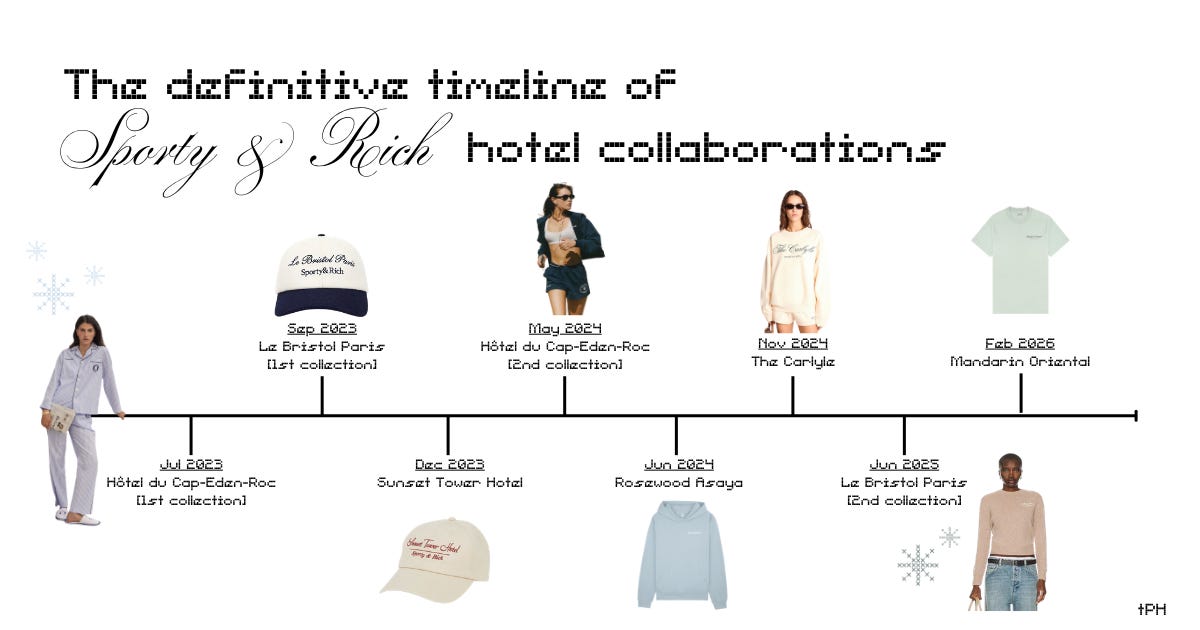
And if you want the receipts, Sporty & Rich in about eighteen months went from one hotel capsule to a standing arrangement with two of the most prestigious hotel groups on the planet (Oetker and Rosewood), doing repeat collections with the same properties, and the company grew immensely as a result.
The party that gained the most brought the least. Yes the hotels got some margin and maybe a younger customer and walking billboards roaming around the world, but they still took the cheaper half of the trade.
Similarly, the Ritz Paris doesn’t need Frame because it can and in some ways already does build the whole thing by itself on its own terms (the Ritz bear and yellow robes are phenomena in their own right), and fashion can only ever gesture from the outside.
✶ ✶ ✶
And that is, dear guest, the cost of staying quiet. If you won’t theorize yourself, someone else will happily theorize you.
There is much, much more to say about this topic (e.g., hospitality activations of fashion brands, hotels that do amazing in-house merch such as the Bowery) but I have a feeling there’s many interesting conversations around this to have with you all before we do so.
Stay sporty and rich,
🔑 Emma
Or we know it’s trying to! or can it? Fashion houses are now leaning into hospitality all. the. damn. time… another piece that needs to be written
"But where are the hospitality critics? Not reviewers!!! Critics!!!"
Your talents are needed more than ever.
Perhaps we need to talk about this more in the live as well, because big yes on everything