

This is part 3 of the tPH 2027 prediction series, where I place my bets on macro and micro phenomena in the hospitality industry for the year ahead. Find part 1 that includes the ground rules and context of the series here, and part 2 here.
Dear guest,
Greetings from Kyoto 🇯🇵
I’m currently enjoying a hard-earned hot chocolate after a day of some serious bathing and sauna-ing at a local sento – a great continuation to my watsu (aquatic bodywork) session at Six Senses Kyoto yesterday. If you ever find yourself here, I can’t recommend it enough. The experience was beyond words!
This week’s prediction has to do with hotel brand partnerships. While I have written about the sort of adjacent topic of hotel merch before (here and here), I do think we are only at the very beginning of a wave of the hotel stay used as ad space. Find out my thoughts and feelings below 😮💨
Great, as if we needed more ads

As soon as we think there couldn’t possibly be more ads thrown at us, we will walk into a hotel room one day and see that even the space that could be considered a sanctuary of anonymity now has product placements in it.
Hotel brand partnerships are a signal that has only strengthened over the past couple of years with the glow-up of the industry, and it is a turn I have very mixed feelings about.
What started as one-off brand activations (nothing new per se but most definitely accelerated with the naissance of influencer culture) has now become a more permanent dialogue that invites brands into the guest’s intimate space and routines. It’s almost as if guests are caught at their most vulnerable, in an unfamiliar space.
Recent example: Nespresso did a campaign at Sofitel hotels called ‘Please Disturb’, where a Nespresso coffee and a croissant are delivered to guests via room service. The collaboration places a brand inside a core hotel service ritual. Nespresso obviously gains access here to an intimate guest interaction, but what’s in it for Sofitel?
Why would a hotel want to do a brand collab?
Easy answer: sold ad space, more money and an added revenue stream.
Standalone hotels (as opposed to hotels with a varied offering, such as a private members' club or branded residences attached) are volatile in their revenue generation. The product is sold by the night, which means nightly occupancy has a huge impact on revenue and profitability.
This is why added and more predictable revenue streams become very attractive. You can sell a brand visibility once, or as an ongoing partnership, and you know its impact de facto, without having to do much more than a simple product placement.
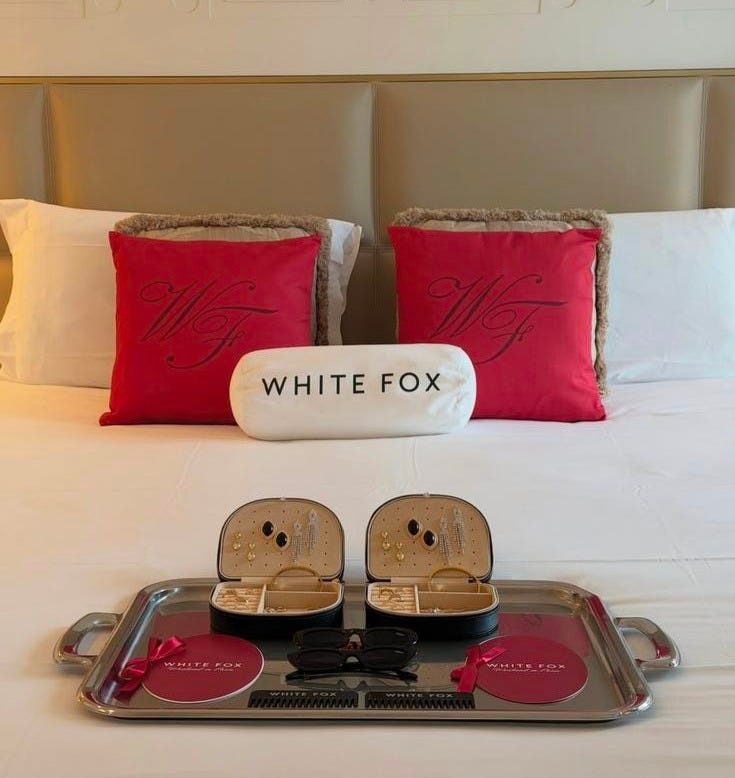
And the brands are just as eager, because a hotel room is highly valuable real estate for them in a couple of different ways. Firstly, the media value generated from a hotel partnership can be unmatched, as guests film their room tours and take pictures of the amenities or near them. Secondly, and way more interestingly in my opinion, the brand gets to create an active relationship with a potential customer by becoming part of the guest’s routines at the hotel, which is a million steps ahead of being on a store shelf.
To be clear, we’re not talking about hotel boutiques or the products for purchase at the spa or specific branded products in the minibar. What we’re explicitly discussing here is when a brand pays the hotel to have its products (or supplies its products to be) displayed in the room or in a service interaction as a ‘gift’ or amenity, i.e., the guest does not pay for it.
But do guests want product placements in the room?
I think intuitively we would all say no, right? I don’t want to walk into a hotel room that I have paid for in order to have to pay more. It’s as if Netflix had ads (oh wait…).
That said, this can be executed in a way where it adds to the experience of the guest and doesn’t feel invasive. Done well, guests celebrate the hotel for it (not in spite of it). Option B is that hotels turn into yet another space for blatant, slop-adjacent advertising that takes away from the stay as the hotel looks to generate that extra branded revenue.
Done well: the beauty cabinet at St Clement, London
St Clement, Nick Jones’ new post-Soho House hotel in London has gotten a lot of attention from luxury hotel heads for its bathroom, where instead of committing to a single amenity brand, every room has a fully stocked beauty cabinet with full-size products from a curated mix of mostly niche brands.
They are yours to enjoy, and the only marketing in sight is a little note from the hotel saying, essentially: please enjoy, our treat. Many guests have found this approach very refreshing now that many hotels have moved into bolted-to-the-wall amenities with nothing to take home (reasons: cost savings, environment, ease… there are many understandable reasons why hotels have chosen to go this route).
Not so much: Santa Monica Proper, LA
Last month I stayed at Santa Monica Proper, also named best hotel in LA by Travel + Leisure The Fast Track (which I booked through The Upgrade | Anne Marie, you should too!!).
The property is unequivocally beautiful, designed by the one and only Kelly Wearstler, with unmatched lobby and lounge spaces. It was mid-century modern HEAVEN! With warm hospitality and good food.
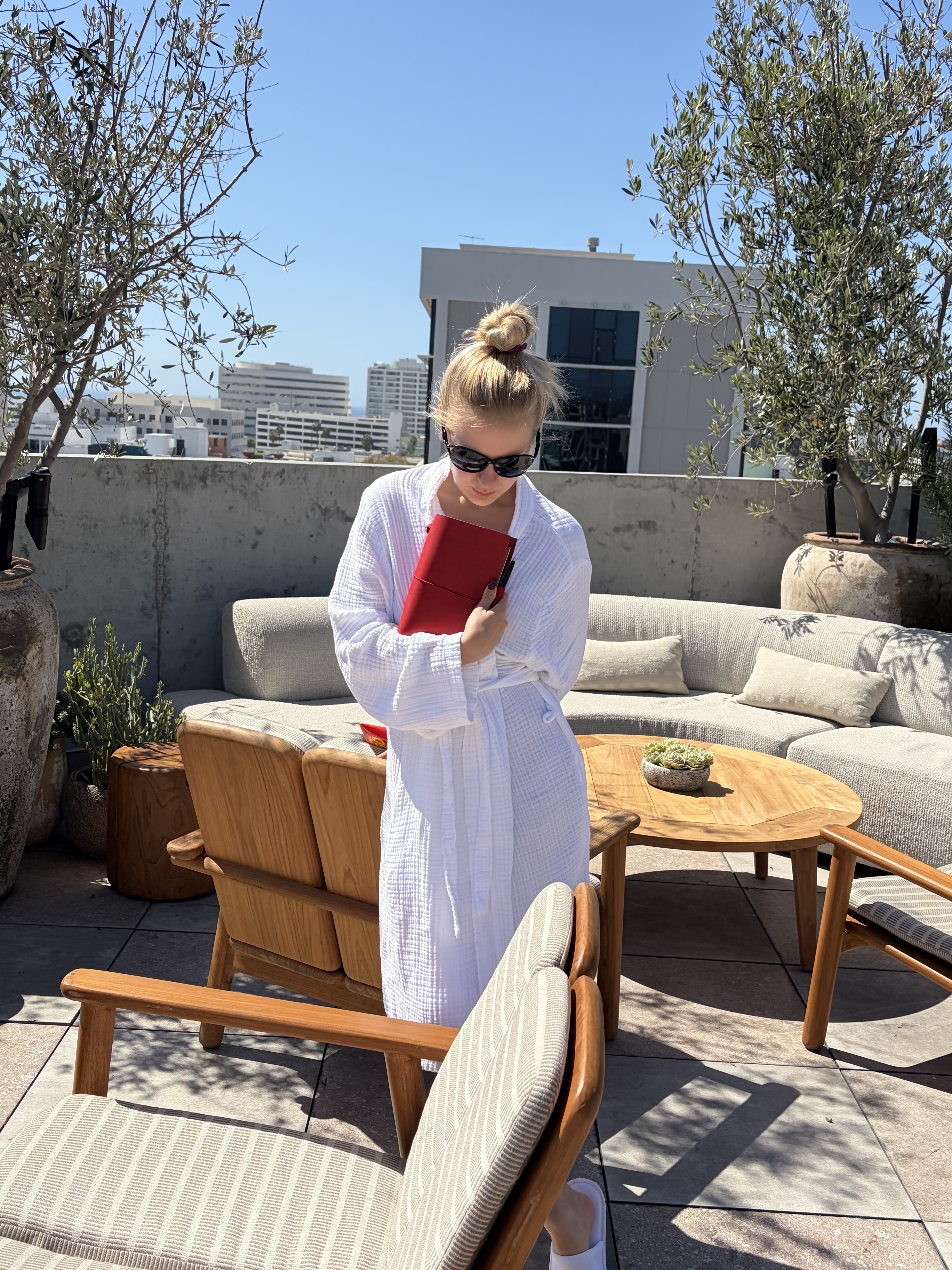
Now! What I saw in the room did not match the rest of the experience. On the counter below the TV there were branded sleep (or beauty or something functional) gummies accompanied with a branded message from the gummy brand going like “our friends at *brand* are providing you with…” (I’m beating myself up for not taking a picture of this so I could properly depict this). I realized in that moment that I was being marketed to, by an external entity (as in not the hotel itself) in my hotel room.
While I moved on from it quickly (I didn’t try the product) and thoroughly enjoyed the rest of my stay at the property, I still find myself thinking about it a lot. I feel like I saw my hospitality life flash before my eyes when I realized this is only the beginning; the ever-ominous ‘they’ has found its way into my sacred space.
Commercial break in your hotel stay 📺
Kant, we need you:
"Act in such a way that you treat humanity, whether in your own person or in the person of any other, never merely as a means to an end, but always at the same time as an end."
– Immanuel Kant, Groundwork of the Metaphysics of Morals (1785)
Thank you Kant.
The difference between the two is obviously that Proper broke the fourth wall of hospitality by reminding me, the unassuming guest, that this stay is a transaction (i.e., you are not a guest, but merely a means to an end - our profit).
St Clement is able to keep up the fantasy and make people EAT their approach to brand partnerships UP because they remain the ‘owner’ of that placement and present it as pure hospitality and generosity. The guest doesn’t need to know about what agreements the hotel and brand have made behind this, they’re just happy to receive, and then go tell everyone they know.
The gummies at Proper were a fantastic and on-brand perk, but the framing made them have the opposite of the desired effect, at least on yours truly.
We live in a world where everything is ad space and everything is for sale, so of course, now that hospitality is finally getting the cultural attention and capital it deserves, brands are lusting for a piece.
The hotel inherently captures some very emotionally loaded moments that products could never even dream of. In 2027, we will for sure see more brand partnerships in rooms (especially at budget to midscale properties where great hospitality is not expected to the same extent) and more “curated by *brand*” amenity programs (especially at luxury properties). Brands will continue to push deeper into the most private spaces we have.
If this is the direction, let it be St Clement’s approach so that the trade off isn’t so painfully apparent. Respect the guest <3
I hope you enjoyed part 3 of tPH’s 2027 predictions. Have you come across this already? How did you feel about it? Good, bad, neutral?
Tell me in the comments, I need to know:
Short extra note from Kyoto: Japanese hospitality is in many ways so understated yet SO intentional, I feel inspired ✧。٩(ˊᗜˋ )و✧*。
I’m in awe of the care with which service interactions are performed here. I feel held.
Until next week,
Emma
Thanks for the shoutout! Glad you enjoyed the Proper. Ill pass on your feedback about the brand messaging w the gummies to their GM
I think the entire mini bar, in some ways, is an ad in plain sight - and absolutely the bar itself! Think about all those patron bottles 🙄 I think I’d get too carried away at that St. Clement…. Breaking the fourth wall does feel like a sin tho….