

This is part 2 of the tPH 2027 prediction series, where I place my bets on macro and micro phenomena in the hospitality industry for the year ahead. Find part 1 that includes the ground rules and context of the series here.
Dear guest,
Tomorrow I fly out to Kyoto, and it will be the first time that yours truly sets foot on Japanese turf. It’s about time!
I’m doing interesting reportage that I can’t wait to share with you once we have this prediction series behind us (the final number of articles in this series is still undecided).
That said, be on the lookout for a postcard at the end of the posts in the next two weeks to see what I’m up to.
But today: my crystal ball shows that many of the eager hospitality industry entrants who do not understand the inherent unquantifiableness of hospitality will get a rude awakening in the big 2027. Read on to find out if you’re at risk 👇
A hotel is a sentient entity
My favorite way to describe what a hotel is, in real estate terms, is the following:
A hotel is a living, breathing piece of real estate.
As much as it is beds, walls, and a roof, it is even more a thing with a mind of its own; an organism of sorts, where guest and staff alike are participants.
I find it very hard to put this sentience of the hotel into words, as it almost resists being defined in its multifacetedness.
Hospitality, that act which takes place at the hotel, is a perishable thing that exists in that moment only, and because it involves a human (even in automated hotels we can count on the guest being part of the equation) it’s always influenced by an infinite number of abstract variables, including elusive concepts such as ‘mood’ and ‘vibe’, and, most crucially, ‘anticipation.’
The significance of a hotel room today is vastly different to what it was a century ago. We now attach personal meaning to our stays, even see them as vehicles towards fulfillment. At least I know I do!
Fulfillment, as opposed to contentment or pleasure, is no small expectation to put on a product; for a hotel perhaps even more so, when such a large part of the final product is reliant on unpredictable variables.
Most people entering the hotel business are not aware of its realities
Now, we already touched last week on the fact that hospitality is having a hot moment because of a recognition of value both on the individual consumer level (we now prefer experiences and transformation over tangible products) and on a collective level (hospitality is built on human connection, and brands want a taste of human relationship building in an age of distrust and automation).
While all trends point toward hospitality supremacy, I think few of those who have entered hospitality from the outside, solely motivated by these promising tailwinds (🤑) are prepared for the realities and complexity of hospitality.
Reality will start to hit in 2027 📉
Hospitality developments often start with crunching numbers. What piece of real estate are we working with; are we building or revamping; what brands are guests into, what fits the market. All of this becomes a sleek plan that’s going to deliver the desired investment multiples. Great!
HOWEVER.
I think less than 10% of developers (I wanted to say 2% but I’m trying to hold my horses) understand the human side, the living and breathing side, of the business. My prediction is that a whole lot of those coming into the industry from the outside will find themselves with a product that feels flat, empty, hollow (what’s the antonym to resonant??). Guests will book incredible locations and find themselves in dream environments, but simultaneously feel that something fundamental is missing, even eerily so.
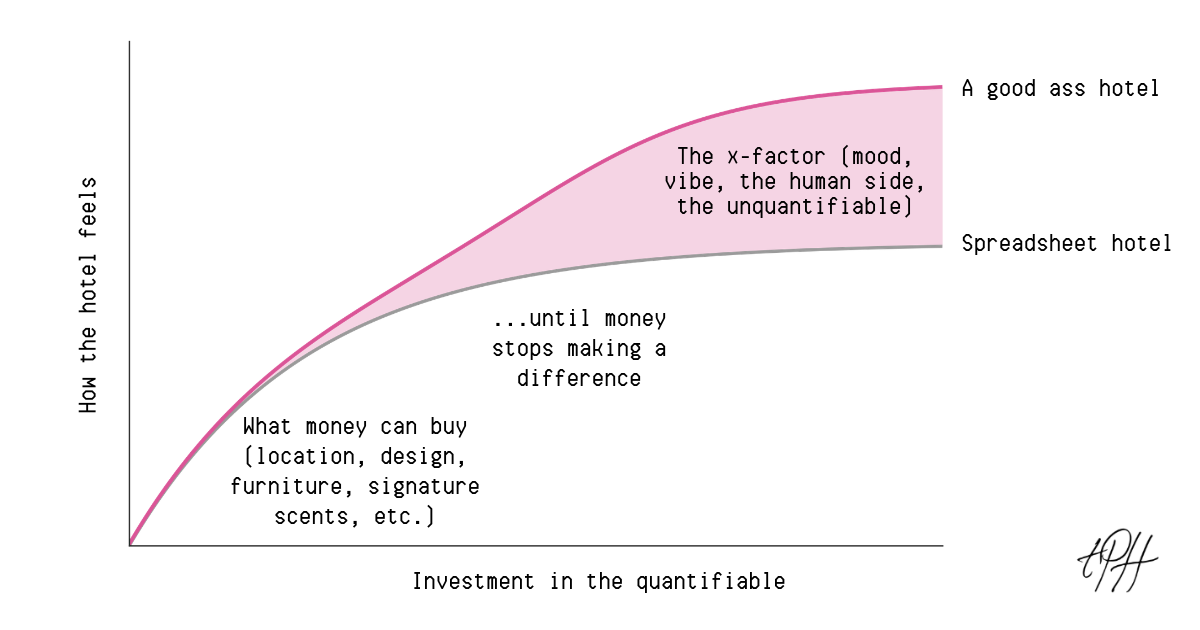
Why? Because a huge part of the business is impossible to quantify. Approaching hospitality as a profit churn always risks strangling the very spirit of it: the same spirit (or the x-factor, the unquantifiable) that makes people value hospitality so much. The same ‘thing’ that makes you and me, dear guest, enthusiastic about the topic.
Examples of what feels wrong: overly standardized places, quote unquote luxury properties where the hospitality and service are lackluster (or feel completely scripted), so-called lifestyle hotels that cater to a completely hypothetical demographic, places where meaningful details are off or inconsistent… I think we’ve all been there.
The unfortunate truth is that many developers and brands just don’t give a hell about the ‘thing’. They see a formula, and just go ahead and replicate it ad absurdum (case in point: the fast-fashionification of hospitality). I mean, as long as we reach occupancy expectations, who gives a shit, right?
But this is a diagnosable level of short-sightedness that I think will end up being the demise of many. You can’t fake hospitality.
To be clear, I’m not big shorting the hospitality industry. I don’t think what I’ve described today will result in any major dips in growth yet. If anything, I do believe in the resilience of the sector, not least because the product itself is relatively protected from being replaced by AI (even if what’s fueling it is not).
However, I do think we will start to see cracks in the sleek surface, such as new openings being discounted way earlier than expected, and near-objectively beautiful hotels being described as soulless. Also, we will most likely start seeing more and more hotels getting rebranded or sold within a few years of opening.
The future of the industry will rest on the reverence with which its humaneness is approached. Otherwise we will end up with a growing sea of hospitality slop.
I hope you enjoyed the second part of tPH’s 2027 predictions. Are you with me on this? Or are the signals you see pointing elsewhere?
Finally, I want to extend my most heartfelt gratitude to all 1k of you. I mean what even!??!? I’m so happy you’re here, seriously. If you wonder how happy, you can see my reaction here.
Although 1k rooms is well in resort territory, there’s still room, for all of you <3
Talk to you soon,
Emma
I wonder if the clearest evidence of hospitality slop will be in repeat bookings. Beautiful design and clever marketing can convince someone to stay once, but getting them to come back is another matter. Maybe the human side of hospitality isn’t entirely unquantifiable. It just takes longer for the numbers to reveal what’s missing.
When you wrote about reality starting to hit, I was thinking more like the reality that occupancy and rate will likely both be flat next year while expenses will continue to grow… that’s the reality for newbies; it’s not all growth in this sector of real estate.