

Welcome to The Reservation, a tPH letter including long-form analysis and cultural criticism of the hospitality industry and relevant trends.
In this letter: the death of the term boutique, neon sign that says good vibes only, instagrammable interiors are a hate crime, and are independent hotels the future of the industry?
In recent letters I have expressed my love for home-like hotels that invite us to dwell, hotels with unlimited attention to detail, and in general hotels that embody third places.
Coincidentally, many of the hotels that check one or more of these boxes are considered boutique hotels.
Pleasing the modern traveller
Boutique hotels often have max 100-200 rooms, creating a more intimate and exclusive vibe. They need not belong to the luxury segment, and, in fact, many of the best I have encountered would count as limited service.
But even though I could, I’m not here today to go on about why I think boutique hotels embody what I love so much about hospitality. Instead, we are going to look at what is threatening its very core: lifestyle hotels.
Boutique hotels are a fast growing and hugely popular hotel type. In my opinion this is the case because they happen to match many of the very things that guests are currently seeking in their stays. Authenticity is a big one, as well as personalization. The reasons and ways people travel have also changed, and the average guest increasingly resembles a hybrid who is traveling to satisfy both work and play.
Many interesting hotel concepts (not boutique per se) specifically catering to this new type of traveller have emerged in recent history as a result of this shift, such as Bob W and Zoku.
This is why we can’t have nice things
Global hotel chains like Marriott and Accor want in on the fun. A JW Marriott, while it has its own angle and offers standardized predictability, is pretty much the furthest thing imaginable from a bespoke locally-rooted and intimately-sized property; an unfortunate predicament as the demand has shifted so much towards the latter.
The solution for these global players has been to add new concepts to their portfolios (either through acquisitions or creating) that try to emulate what guests love about boutique properties. Enter lifestyle hotels.
There are SO many lifestyle brands now, almost to the point of exhaustion, and everyone is hopping on the bandwagon.
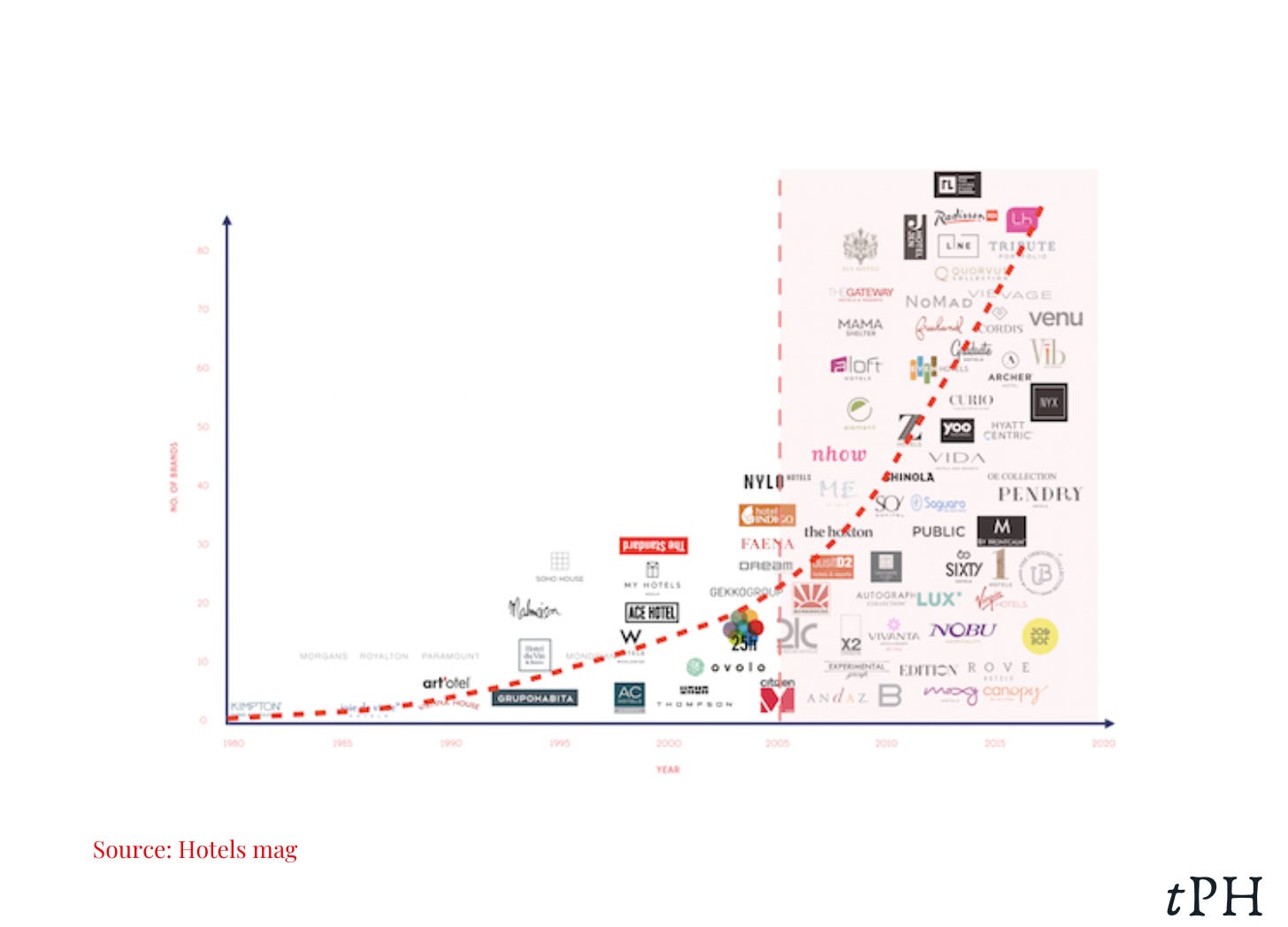
They have been called the next generation of boutique hotels, combining their distinct design charm with global chain prices. The sentiment is… sweet, but what about the execution?
In reality, many of these brands are indistinguishable from one another. This could be attributed to it being a structural feature of global brands to be scalable and replicable.
Also, I would like to note that lifestyle hotels were never really about the place they are located in. A recent study found that consumers expect lifestyle hotels to help them “express personal image” and “enhance social status”… while boutique hotels are more associated with an intimate atmosphere and design that is distinctive to the locale.
Lifestyle hotels are trying to reproduce this authentic feeling of being boutique to the point that the line between the terms has become rather elusive, stretched so thin that it ends up meaning nothing.
More than 50% of travelers in the study couldn’t even define the difference between boutique and lifestyle hotels. This is, of course, useful if you’re a global chain trying to sell something inherently copy-pasteable as something that has real substance and personality.
The lifestyle hotel aesthetic
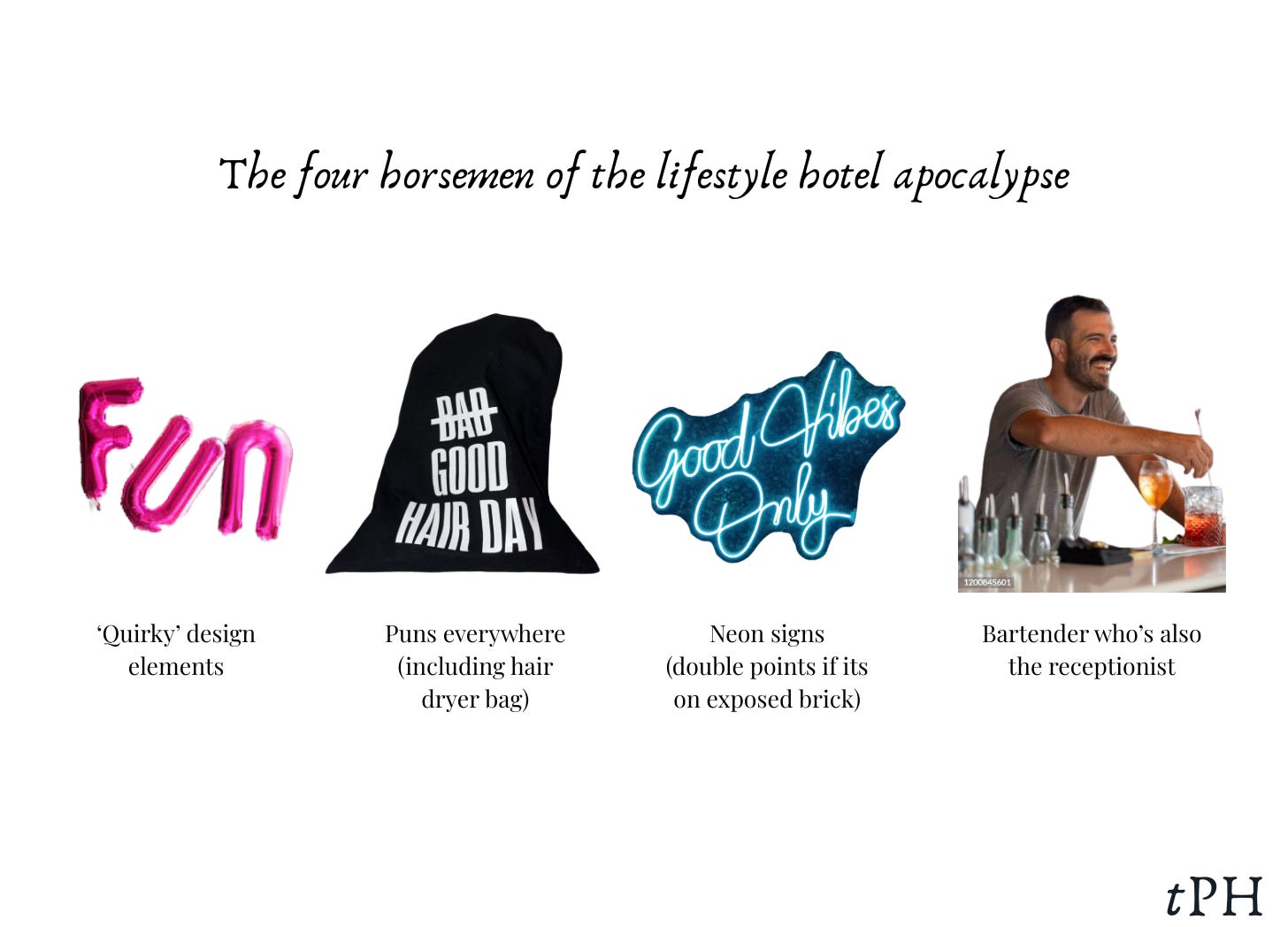
Exposed brick, millennial pink, those lightbulb industrial lamps, a Love Island villa -adjacent neon sign, and many other quirky design elements.
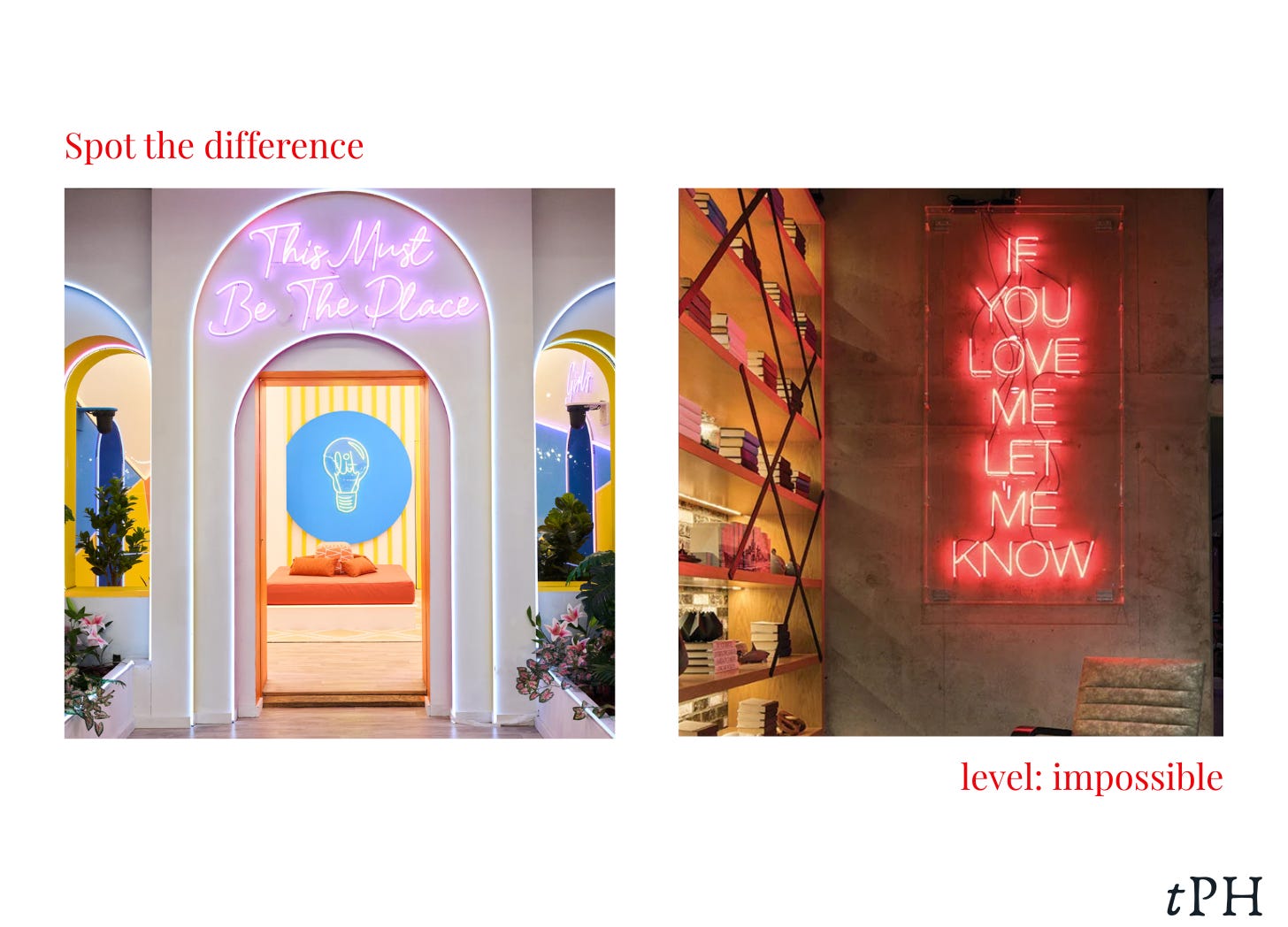
This design approach is SO consistent across lifestyle brands be it Moxy, Mama Shelter, or Canopy (owned by Marriott, Ennismore/Accor, and Hilton respectively), and it’s definitely not an accident.
These hotels are designed to feel special, unique, hip, authentic… while being operationally as replicable as possible.
I have the ick
The ick, for me, is that authenticity means very little when we are discussing a scalable product designed to capture a specific demographic that needs everything to be instagrammable (does this demographic even exist anymore? I heard people are no longer posting).
Still interestingly, the research I mentioned earlier confirms that the people that do stay at lifestyle hotels are more motivated by self-image (i.e., how the hotel reflects who they want to be seen as) compared to those who stay boutique.
So there still seems to be a demographic for lifestyle hotel concepts that are driven by aesthetics (not to be confused with taste), and to be clear, I don’t think there’s anything wrong with that. HOWEVER, these brands should not be confused with concepts that have been born out of passion for hospitality and a drive to refresh a stagnant industry.
Oftentimes in the cases where global brands acquire a concept that created organic loyalty and interest around it, the soul of those independent brands gets flattened as the funnel requires them to become easily replicable.
In other words, the very things that travelers want get diluted when chains try to manufacture it at scale.
A Marriott executive once allegedly admitted (behind close doors) that Moxy was their copycat version of citizenM (this was naturally before they acquired the company). At least they’re honest about it!
Not all lifestyle hotels are evil
Not all hotels that could be considered lifestyle give me the ick.
Take Bob W., for instance. You can probably tell by now from the few mentions of the brand on tPH that there is admiration from my side. I feel like they do everything these branded lifestyle hotels set out to do but for real!!!
The locations are actually, by design, locally rooted, in converted office or apartment buildings, with breakfast served at a local café.
Why this is different from a run-of-the-mill lifestyle brand is that there is real point of view and vision that predates the trend.
Again, a disclaimer: global chains are capable of genuine excellence (specifically in the luxury segment with names such as St. Regis or the Ritz) and I’ve had the pleasure to meet many incredible dedicated people behind their portfolio brands that know what they are and do it beautifully.
The scale is not the icky part but rather the flattening and soullessness of it all.
Will there be a reckoning?
If you are operating or developing a hotel, I assure you, “lifestyle” is not something you should chase, coming from a gen-z girly who is probably somewhere on that target segment moodboard.
Instead, your time and money are much better spent by asking what you actually believe about the industry and the modern guest, and make that the guiding principle.
Concepts born this way have much more longevity than jumping on the lifestyle bandwagon for a short-term return horizon.
Now I need to hear your thoughts! Have you come across good lifestyle hotels? What are your icks? Can a lifestyle hotel ever compare to a boutique hotel?
Ciao ragazzi see you next week,
🔑 Emma
Your point about boutique hotels being rooted in place versus lifestyle hotels being rooted in identity projection is one of the clearest ways I’ve seen this explained. One asks, “Where am I?” and the other asks, “Who do I look like when I’m here?” That said, the hyper-curated Instagrammable formula (what even is that?) feels exhausted. The reality is, the properties that resonate most are the ones with actual conviction behind them, even if imperfect, rather than those assembled from the “creative cool starter pack” of neon signs and brushed concrete. Ick, indeed!
I agree in premise, but I also think these lifestyle hotels play an important part in the migration from base chain to boutique "FATTravel" properties. Taste is a gradient, and having a defined point of view, even if en masse, is the beginning of finding your own definition as a guest. So much is being focused at the top of the K-Shape, there is open space for "you know what you're going to get and it's going to be pretty." For instance, I am a huge Nomad stan - it's deliberate and scalable with reliably amazing service and breakfast (the two things I care most about other than water pressure).